

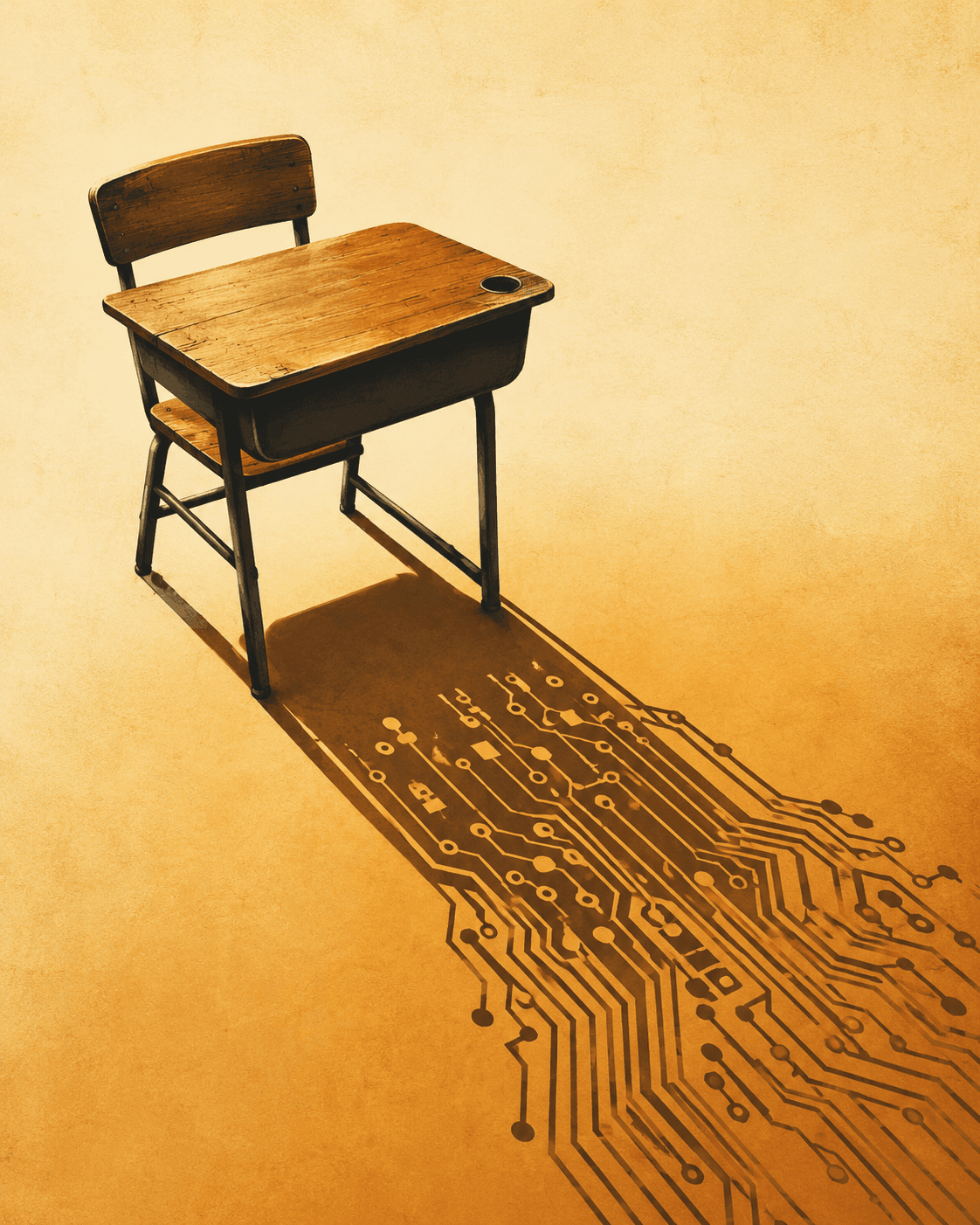
Artificial intelligence isn't replacing teachers — it's reshaping what teaching and learning can mean. Here's what the shift actually looks like, and why it matters more than the hype suggests.
For most of human history, education looked roughly the same: a knowledgeable person in front of a room full of students, transferring information at the pace of the slowest learner and the patience of the fastest. The classroom was, by design, a compromise — and like most compromises, it left nearly everyone somewhat unsatisfied.
That is changing. Not with the dramatic fanfare of a revolution, but with the quiet persistence of a tide. Artificial intelligence has moved from the margins of EdTech into its beating center, and the implications — for students, for teachers, for the very idea of what it means to learn — are only beginning to reveal themselves.
From One-Size to One-to-One
The oldest promise of educational technology is personalization: the dream that every student might receive instruction tailored precisely to their needs, pace, and learning style. For decades, that promise outpaced reality. Early adaptive learning platforms were rigid, prescriptive, and often more frustrating than enlightening.
Modern AI systems are something genuinely different. Large language models and sophisticated recommendation engines can now build dynamic, continuously updated models of individual learners — tracking not just what a student got right or wrong, but how they think through problems, where their misconceptions cluster, and what kinds of explanations resonate most deeply with them.
The shift is conceptual as much as technical. We're moving from systems that adapt the difficulty of content to systems that adapt the nature of the relationship between learner and knowledge — understanding that a student who struggles with algebra may not need more algebra problems; they may need a different way of seeing what algebra is for.
In practice, this looks like an AI writing tutor that doesn't just flag grammar errors but notices a student consistently avoids hedging language — suggesting not a grammar problem, but an anxiety about making definitive claims. It looks like a mathematics assistant that recognizes a learner understands the formula but not the intuition behind it, and pivots accordingly.
The Teacher's New Role
Predictably, the arrival of AI in education has triggered anxious questions about teacher displacement. The anxiety is understandable, but the framing is wrong. Education's history is littered with technologies that were supposed to make teachers obsolete — educational television in the 1960s, the internet in the 1990s, MOOCs in the 2010s. None of them did.
What they did, at their best, was free teachers from the most mechanical aspects of their work: drilling facts, delivering the same explanation for the twelfth time, grading routine assessments. AI is doing this more powerfully than any predecessor. And in doing so, it is returning to teachers something precious: time.
Time for mentorship. Time for the messy, unpredictable conversations about meaning and motivation that no algorithm can replicate. Time to notice the student who is technically performing but emotionally absent. Time to celebrate the small victory that data doesn't capture.
"The best teachers have always done this instinctively. What AI offers is the ability to do it at scale — for every student, in every moment, without fatigue."
Early adopters report something counterintuitive: classrooms with strong AI integration often feel more human, not less. When routine tasks are handled, the group time that remains can be reserved for discussion, debate, creation, and collaboration — the activities that benefit most from being done together.
Academic Writing, Reimagined
Nowhere is the AI transformation more profound — or more contested — than in writing. The concern that AI will hollow out academic writing as a demonstration of thinking is legitimate and worth taking seriously.
But the more interesting possibility runs in the opposite direction. AI writing assistants, when designed thoughtfully, don't write for students — they think alongside them. They ask the question the student hasn't thought to ask yet. They push back on the weak claim. They surface a contradiction between paragraph two and paragraph seven that the writer was too close to see.
The goal is not a better-written essay. The goal is a student who, through the process of working with an intelligent interlocutor, becomes a better thinker. The essay is evidence of that growth — not a product that can be outsourced.
This is, essentially, what a skilled writing tutor does in a one-on-one session. The magic of that session has always been scarcity — most students never get it. AI makes it available every time a student opens a document, at whatever hour inspiration or deadline strikes.
Equity: The Hardest Problem
The most compelling case for AI in education is also the most demanding one: equity. The students who have always benefited most from personalized instruction, private tutoring, and expert feedback are, almost without exception, the students who needed it least.
AI, deployed thoughtfully, has the potential to compress that advantage — to bring a sophisticated intellectual interlocutor to:
A student in a rural school with limited access to specialist teachers
A first-generation university student without access to office hours culture
A learner writing in a language that isn't the dominant one at their institution
That potential is real. So is the risk that it goes unrealized — that AI tools are adopted fastest by the institutions that already have the most, widening existing gaps rather than closing them. The technology itself is agnostic. The outcomes will depend on choices made by policymakers, institutions, and developers.
What We Should Actually Be Worried About
The fears that receive the most attention — cheating, job loss, the death of critical thinking — are mostly either overstated or already solvable. The concerns that deserve more attention are subtler.
Epistemic dependence — Students habituated to AI assistance may lose confidence in their own unassisted judgment. Good AI design works against this tendency, scaffolding without replacing — but bad design creates the opposite effect.
Bias and representation — AI systems trained predominantly on certain bodies of knowledge, in certain languages, reflecting certain cultural assumptions, will reproduce those limitations at scale. Multilingual learners and students from non-Western academic traditions deserve particular attention.
The measurement trap — The temptation to optimize for what AI can measure rather than what education is actually for. Learning has always included outcomes that resist quantification: the intellectual courage to hold a position under pressure, the imagination to see problems differently, the empathy to understand a perspective unlike your own.
The Shape of What's Coming
We are early in this shift. The tools available today are impressive; the tools available in five years will be almost unrecognizable by comparison. The institutions, pedagogies, and policies that will govern their use are largely still being formed.
The decisions being made now — by developers building AI educational tools, by administrators choosing whether and how to adopt them, by teachers deciding what role they want to play in an AI-augmented classroom — will shape the educational landscape for a generation.
The quiet revolution is already underway. The question isn't whether to participate in it, but how — with what values, toward what ends, for whose benefit.
Those are not technical questions. They are, at bottom, the oldest questions in education:
What is learning for? And who gets to have it?
© 2026 VegaLearn · The Learning Curve